
Your Flyweels Manufacturers
We 13 years of CNC machining experience.In 2015, Jenkin decided to enter foreign market.Currently, we have 27 CNC 3 axis milling machines, 1 CNC 5 axis machine, 2 lathes and 3 CNC mill-turn combination machines.
Why Choose Us
Precision and Quality
At our manufacturing facility, we prioritize precision and quality above all else. Our state-of-the-art equipment and experienced team ensure that every part we produce is crafted to exacting standards, with exceptional attention to detail.
Comprehensive Capabilities
With a wide range of manufacturing capabilities, including plastic injection molding, metal injection molding, aluminum die casting, zinc die casting, and laser cutting, we can handle all of your custom metal and plastic parts needs in-house. This means faster turnaround times and greater control over the production process.
Flexibility
We're flexible and adaptable to meet the unique needs of each of our clients. Whether it's a small, one-off project or a large-scale production run, we can tailor our manufacturing process to suit your specific requirements.
Certification
As a ISO9001 certificate CNC machining manufacturing vendor, we not just provide high quality production service, but design engineering solutions.
-

Russia_MTZ-flywheel CNC Turning
Russia_MTZ-flywheel CNC turning Add to Inquiry -
Racing Car Flywheel Processing Accessories Flywheel Assem...
Racing car flywheel processing accessories flywheel assembly steel Add to Inquiry -
Porsche718_911_Panamera_Macan_flywheel Enginer Gear Box
Porsche718_911_Panamera_Macan_flywheel enginer gear box Add to Inquiry -
Nissan RG8engine Flywheel140gear_10_RF8_cluth Pressre Pla...
Nissan RG8engine flywheel140gear_10_RF8_cluth pressre plate UD_NISSAN Add to Inquiry -
Jazz_city_Honda Gearbox Clutch Flywheel
Jazz_city_Honda gearbox clutch flywheel Add to Inquiry -
HILUX 3L 5L LN67 LN107flywheel 13405-54080
HILUX 3L 5L LN67 LN107flywheel 13405-54080 Add to Inquiry -
High-performance Steel Custom CNC Turning Flywheel
High-performance Steel custom CNC Turning flywheel Add to Inquiry -
High-performance Engine Flywheel Engine Cluth
High-performance engine flywheel engine cluth Add to Inquiry -
High-performance AUTO Flywheel Passat Lang Etuan Baolai M...
High-performance AUTO Flywheel Passat Lang Etuan Baolai Magotan gea Add to Inquiry -
Guangqi Hino 700_E13Cengine _Flywheel_Mixer Truck_Tractor...
Guangqi Hino 700_E13Cengine _Flywheel_Mixer truck_Tractor accessories_HINO Add to Inquiry -
German Benz Truck AccessoriesOM904 Flywheel
German Benz truck accessoriesOM904 flywheel Add to Inquiry -
Automotive Flywheel Engine Parts Automotive Assembly
Automotive flywheel engine parts automotive assembly Add to Inquiry


Types of Flywheels and Their Usage
Solid Disk Flywheels
Two different types of stresses are used in solid disk flywheels – radial stress and tangential stress. These high-utility tools typically have a disk and a hub section. In order to get a proper idea about the usability of a solid disk flywheel, its 'mass amount of inertia' has to be calculated (by using the disk mass and the outer radius). The density of the flywheel material also has to be considered.
Rimmed Flywheels
The main parts of a rimmed flywheel are its inner hub, outer ring (also known as the 'rim'), and arms. Generally, rimmed flywheels have 4-6 arms. A definite centrifugal force is exerted on the rims of the flywheel – and that generates tensile stress on it. The moment of inertia of the rim, along with the factor for the mass moment of inertia, are important parameters of rimmed flywheels.
High-Velocity Flywheels
The rakish speed of high-velocity flywheels generally varies in the 30K rpm and 60K rpm range. If required, this velocity can be increased to a certain extent. The user-friendly and lightweight nature of these flywheels is one of the biggest reasons behind their popularity. The cost of high-velocity flywheels is usually higher than that of low-velocity flywheels.
Low-Velocity Flywheels
The angular velocity of low-velocity flywheels is significantly lower than their high-velocity counterparts (generally, the maximum speed of these flywheels is 10K rpm). While they are relatively cheaper in terms of cost, the huge size of low-velocity flywheels can prove to be a challenge. Unlike high-velocity flywheels, a low-velocity flywheel does not have handy levitation directional features. In addition, the latter also requires support on an intermittent basis. When installed correctly (generally, with additional construction support), low-velocity flywheels deliver efficient and economical performance. Buyers should get the different parts of these flywheels inspected from time to time.
Single Mass Flywheels
Single mass flywheels are manufactured with a single piece of casting material, and they do not have any movable pieces. They facilitate fast-revving of engines and help to maintain a stable connection between the engine and the clutch assembly system. The enhanced warp resistance and thermal resistance of single mass flywheels are big advantages – and these flywheels can withstand sudden changes in gear and engine speed.
Dual Mass Flywheels
There are two separate flywheels in a dual-mass flywheel – the first fitted to the clutch, and the other to the crankshaft. These flywheels have very good weight capacities (up to 50 kg) and monthly capacities. Diesel vehicles that are rather large in size and have manual transmissions generally use dual-mass flywheels (select petrol vehicles use them too). The strong springs in the flywheels minimize torsional spikes and keep the gearbox protected.
Flywheels are Used in Various Manufacturing Processes
Presses and Punching Machines
They provide extra power during heavy operations.
Machining Tools
Flywheels help maintain consistent speeds for precision work.
Textile Manufacturing
They keep looms and other machines running at steady speeds.
Energy Recovery Systems
Flywheels capture and reuse energy, improving efficiency.
Common Flywheel Depths
|
Depth |
Size & Description |
|
1.062 |
13" 2 Pl. Ford (Cat & Cum.) (0704, 1081) |
|
1.062 |
13" 2 Pl. I.H.C. (Diesel) (13-1081,13-1140) |
|
1.062 |
13" Lipe, 14" Ford Cat. (0588 & 1072) |
|
1.477 |
13" 2 Pl. Ford (6104) (Gas) |
|
1.093 |
14" Lipe, (14-665 & 1113) |
|
1.187 |
14" Lipe, 14" Long (9229) 14" Rockford (5245) |
|
1.498 |
14" Leyland (152726) |
|
1.710 |
14" Isuzu (31220, 31210, 30210) |
|
1.812 |
14" Single Pl. Spicer (127186) |
|
2.937 |
14" 2 Pl. Spicer (127390, 400) LP Lipe (14-1777, 1778) |
|
1.595 |
14"-15" Mack (4106 & 4108) (Single Pl.) |
|
2.582 |
15" GMC Bus 2 Pl. (0163) |
|
2.796 |
15" Mack 2 Pl. (4107) |
|
1.496 |
15" Valeo Mack (72615) |
|
1.750 |
15" Lipe (DPB) 15" Rockford (5393) |
|
1.225 |
15 1/2" Lipe TC (155-377) |
|
1.325 |
15 1/2" Long (7547) |
|
1.670 |
16 1/2" Mack (4138) |
|
2.321 |
17" Lipe TC 2 Pl. (17-737) |
|
1.218 |
17" Lipe, TC Single Pl. (17-355) |

Would You Know the Difference Between a 'Dual-Mass Flywheel' & 'Single Mass Flywheel'?
A dual mass flywheel is a flywheel in 2 concentric parts or 2 facing flywheels stuck together with a flexible compound to damp down transmitted vibration and gear rattle.
Many trucks that come with dual-mass flywheels can be converted to single mass flywheels. Some of the benefits of doing so include an increase in acceleration, reduced turbo "lag" with turbocharged engines, and increased supercharger efficiency.
Single mass flywheels can be resurfaced and reused, while a dual mass flywheel cannot. Dual mass flywheels also, cannot withstand a high rate of abuse & may fail sooner under certain driving conditions.
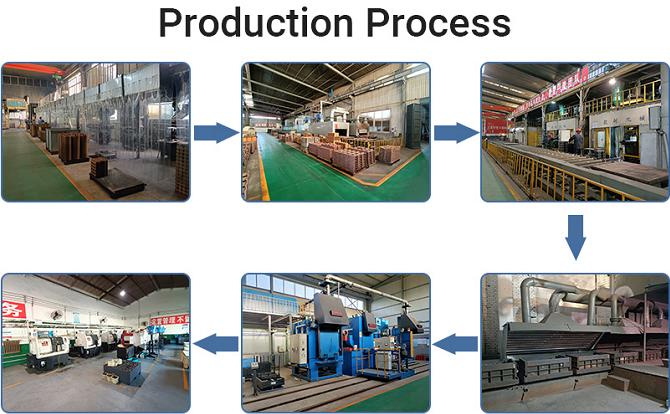
Production Process of Flyweels
Our Flyweels production process include resin sand molding line, shell molding line, green sand casting and lost wax investment casting production process.
Quality Control
Checking the raw material after they reach our factory------- Incoming quality control
Checking the details before the production line operated
Have full inspection and routing inspection during mass production---In process quality control
Checking the goods after they are finished---- Final quality control
Checking the goods after they are finished-----Outgoing quality control
Custom Cast and Machined Flywheels Services
Our experienced staff will work with your engineering staff to efficiently and cost-effectively manufacture a custom cast or machined flywheel to meet your specific requirements. We manufacture all the components of the flywheels, including ball bearings. Your flywheels can be manufactured by casting or machining from a wide selection of metals, ensuring the precision and performance your application requires. We manufacture quantities from short runs through full production runs.
Our flywheel manufacturing services include:
Turnkey fabricating and machining services – Our manufacturing services include metal fabricating, CNC machining and turning, fineblanking, laser cutting, drilling, finishing, and assembly.
In-process quality control – All of the parts and components manufactured by LYNX are manufactured using the Toyota quality system, including in-process quality control. We adhere to Level 3 PPAP standards so that you can be assured that your products are delivered production-ready. LYNX is ISO 9001-2008 certified.
Local delivery – We operate 3 stocking warehouses in the U.S.
Vendor-managed inventory program – LYNX can manage your production inventory and supply chain through our standing order and just-in-time delivery program.
U.S. payment terms – LYNX is based in the U.S., so we offer invoicing and payment through our U.S. offices. You don't need to worry about letters of credit, prepayments, or the other inconveniences of working directly with foreign manufacturers.
FAQ
We're well-known as one of the leading flyweels manufacturers and suppliers in China. Please feel free to wholesale high quality flyweels at competitive price from our factory. For more information, contact us now.
5-axis CNC Machining Parts, Plastic Components, Black Anodised Aluminium Square Tube